
Before Guilford, there was New Haven — the real one. Working families stacked shoulder to shoulder. Kids everywhere. Adults who didn’t need to pretend. That’s where my parents built their life.
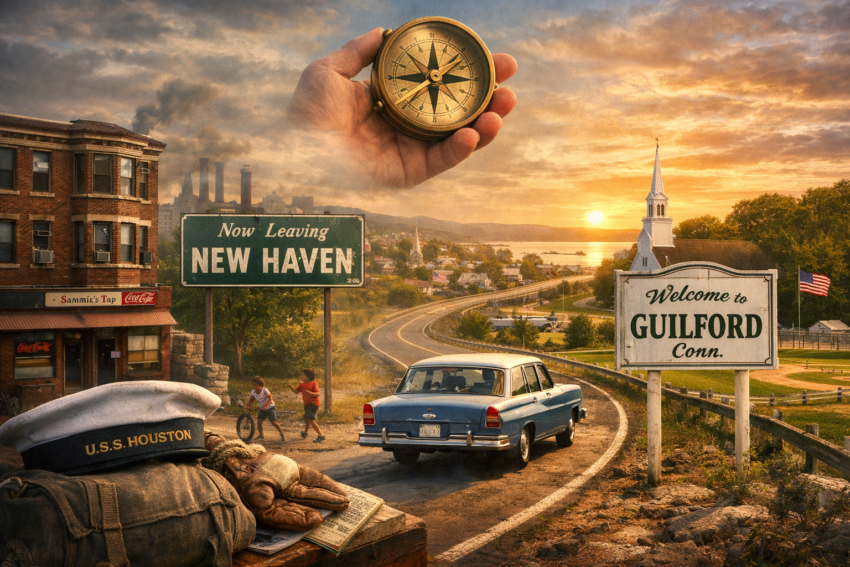
My father, Bud, came home from the Pacific with a compass forged in fire. Seventeen at Leyte Gulf. The USS Houston burning. Boys dying. Men being made in minutes. After that, the small stuff never registered the same way again.
He used the GI Bill the way it was meant to be used — bought a half‑duplex at 14 Valley Place South, New Haven Ct. in a mixed‑race neighborhood full of real people living real lives.
He fit there.
Bowling leagues.
Treasurer for Biddy Basketball.
Coaching kids whose fathers were working late shifts.
Community, not charity. Responsibility, not ego.
My mother fit there too.
Sunday school.
Cub Scouts.
Girl Scouts.
Running concessions at Biddy League games.
She wasn’t “helping.” She was the backbone — the person who made the whole thing run.
My older siblings grew up in that world — the 1950s version of my parents. Young, strict, busy, doing everything by the book because that’s what the era demanded.
Then the city changed.
New Haven in the late 60s was alive — politically, socially, racially. My siblings were old enough to feel all of it. My brother was at Hillhouse High during the years when the Black Panthers were present on campus. Not the caricatures. Not the headlines. Young men protecting their own community in a city that was boiling.
There was a moment — before we moved — when the Panthers escorted my brother out of Hillhouse. Not as a target. Not as an enemy. As a friend. They saw him as someone worth looking out for. That’s the New Haven my family lived in. Complicated. Honest. Human.
Then came the move to Guilford.
People like to call it white flight. That wasn’t my parents. They weren’t running from anything. They were running toward something — space, schools, a quieter life after years of raising four kids in a city that never slept.
But Guilford wasn’t New Haven. It looked like opportunity, but it ran on unspoken rules and inherited social circles. A kind of polite sorting you could feel without anyone saying a word.
My father walked into that town the same man he’d been in New Haven. Same compass. Same willingness to help. Same instinct to raise his hand. He tried to volunteer in Little League and basketball the way he always had. The air was different. Closed. Small.
He didn’t shrink. He didn’t adjust. He didn’t argue. He simply recognized the place for what it was and stepped back.
And that’s why he wasn’t at my ballgames.
Not because he didn’t care.
Because the environment was toxic.
He’d lived through real community. He knew the difference.
He wasn’t going to sit in bleachers built on social currency and quiet bigotry.
He wasn’t breathing that air.
My mother felt it too. She didn’t volunteer in Guilford because she didn’t need to. She didn’t need to prove anything. She didn’t need to squeeze herself into circles that weren’t built for her. She wasn’t excluded — she just wasn’t interested.
It wasn’t defiance.
It was awakening.
My older siblings were the first to feel the shift. My sister lived with my aunt in Hamden for a year. My brother finished at Hillhouse. They were old enough to know the new town didn’t match the world they came from.
Me — and my little sister — we assimilated. Kids do. We learned the codes. We blended in. We lived the surface version of the town while our parents carried the weight of the transition.
And here’s the twist that only makes the story more honest:
In 1983, I married the chief of police’s daughter.
That’s what assimilation looks like.
Not betrayal.
Not contradiction.
Just the reality of growing up inside a system your parents never fully entered.
But underneath all of it, the inheritance was already set:
What would Dad do.
What will Mom think.
Follow the compass.
Move forward.
Don’t bend for smallness.
That’s the story before the 70s.
Before the docks.
Before the freedom.
The story of a family that lived real life in New Haven, stepped into Guilford with open eyes, and kept their humanity intact.
The story of a brother escorted out of Hillhouse by Panthers who saw him as a friend.
The story of a father who wouldn’t sit in toxic bleachers.
The story of two parents who woke up to the truth of a new place — and kept moving forward without needing permission.
The story of where you really come from.