

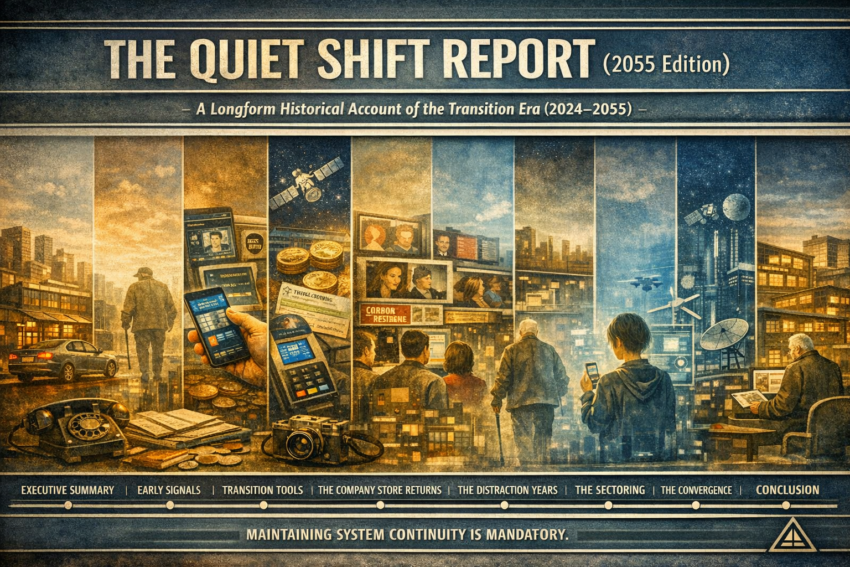
A Longform Historical Account of the Transition Era (2024–2055) Prepared for archival release by the Institute for Systems Continuity
I. Executive Summary — The World That Updated Itself
A calm, matter‑of‑fact overview:
- No revolutions
- No collapses
- No turning points
- Just updates
- Just drift
- Just systems reorganizing themselves faster than institutions could respond
This section sets the tone: quiet, forensic, unsentimental.
II. The Early Signals (2024–2028)
This is where you fold in:
- The Quiet Shift
- The Lost Chapter
- Tools We Ignored
Key themes:
- incremental policy changes
- new ID systems
- new payment rails
- “temporary” emergency measures
- predictive algorithms introduced as convenience
- the first signs of infrastructure acting like governance
This section ends with the thesis: The future didn’t arrive. It accumulated.
III. The Tools That Built the Transition (2020s)
This is the backbone of the report — the part that feels like a Ken Burns documentary crossed with a Brookings white paper.
1. Predictive Policing → Predictive Governance
Palantir’s early models Behavioral forecasting Risk scoring The shift from enforcement to redirection
2. Carbon Markets → Universal Pay
Financialization of natural processes Programmable units The logic of standardization
3. Privatized Surveillance → Territorial Oversight
Satellite networks Environmental monitoring Population density tracking Resource‑based redirection
4. Stablecoins → Digital Currency Infrastructure
Argentina as the testbed Programmable money Ledger‑based consumption
5. The Sensor Stack → The Nervous System
Sidewalk Familiar Faces Flock The mesh → identity → mobility → fusion architecture
This section is the “technical autopsy” of the drift.
IV. The Company Store Returns (2026–2036)
This is where The Company Store document plugs in.
Themes:
- housing consolidation
- employment‑tied residency
- automation and absence
- penal labor expansion
- the closed loop: housing → labor → incarceration → housing
This section is observational, not dramatic.
V. The Distraction Years (2032–2038)
This is the missing piece you added — and it’s one of the strongest.
A single, emotionally radioactive scandal consumes the public. Not coordinated. Just overwhelming.
While the public argues, the real machinery advances:
- predictive governance
- digital rationing
- standardized housing
- algorithmic work assignments
- privatized infrastructure
This section explains why the shift went unnoticed.
VI. The Sectoring (2038–2048)
This is where The Quiet Shift and Dystopia converge.
Themes:
- population balance sectors
- resource sectors
- administrative sectors
- mobility scoring
- predictive redirection
- the rise of the Star (unified enforcement emblem)
This section is calm, procedural, inevitable.
VII. The Analog Fade (2040–2055)
This is where your best insight lives.
Themes:
- the last analog generation
- the time‑buying period
- the disappearance of comparative memory
- digital natives inheriting the substrate
- the system no longer needing to justify itself
This is the emotional core of the report — quiet, reflective, devastating.
VIII. The Convergence (2048–2055)
This is the final architecture:
- AWS runs the digital grid
- BlackRock owns the physical grid
- Palantir interprets the data from both
- Universal Pay becomes the operating system of life
- Sector Offices replace traditional governance
- Predictive allocation replaces policy
This section is the “reveal,” but without drama — just structural clarity.
IX. Conclusion — The Update Completed
The world didn’t collapse. It updated.
And the update installed itself while people were:
- distracted
- exhausted
- overwhelmed
- arguing
- aging out
The Quiet Shift Report ends with the same calm inevitability that defines your entire universe.