

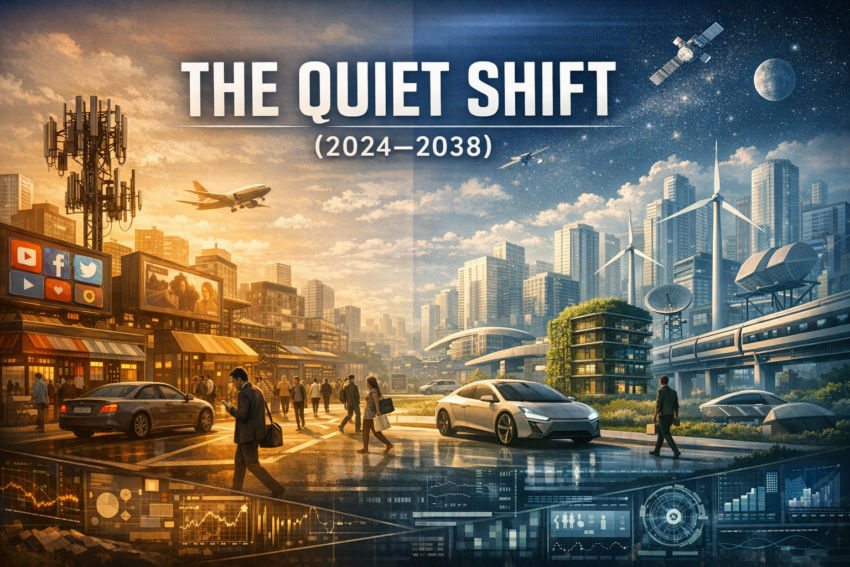
I. The Quiet Shift (2024–2038)
Historians call this the period when the world changed without announcing it.
There were no revolutions. No turning points. No Day One.
Just:
- new ID apps
- new payment systems
- new “temporary” emergency measures
- new housing initiatives
- new predictive algorithms
Every update was small enough to ignore. Every tradeoff felt reasonable. Every loss was incremental.
People didn’t lose freedom. They traded it — a little at a time.
II. The Tools That Built 2055
1. Predictive Policing → Predictive Governance
Palantir’s early systems weren’t about crime. They were about population modeling.
By 2055, this logic matured into:
- standardized work assignments
- mobility scoring
- behavioral forecasting
- resource‑based redirection
The police precinct became the Sector Office. The police star became the Sector badge.
No one is arrested. They are reassigned.
2. Carbon Markets → Universal Pay
The carbon‑credit era revealed a simple truth:
If you can financialize carbon, you can financialize anything.
By 2055, every natural process — and every human action — is a measurable unit.
Universal Pay emerges from this logic:
- calories
- kilowatts
- miles traveled
- water usage
- household goods
All of it flows through a programmable ledger.
Not to punish. To standardize.
Variability is the enemy of predictive systems.
3. Privatized Surveillance → Sector‑Based Population Management
The satellite networks of the 2020s — sold as environmental monitoring — became the first draft of territorial oversight.
By 2055, satellites track:
- population density
- water tables
- energy strain
- land use
- movement patterns
People don’t move because they want to. They move because the model says Sector 14 is stressed or Sector 3 needs balancing.
The satellites don’t just watch the land. They watch us.
4. Stablecoins → Global Digital Currency
Argentina was the testbed.
Stablecoins filled the vacuum of a collapsing currency — not as rebellion, but as onboarding.
By 2055, digital currency is the operating system of life:
- every purchase
- every calorie
- every mile
- every object
- every service
All programmable. All trackable. All rationed.
Stablecoins were the beta. Universal Pay is the release build.
5. Infrastructure Became Governance
By the 2020s, the largest corporations didn’t just have investments. They were the environment.
- AWS ran the digital grid
- BlackRock owned the physical grid
- Palantir interpreted the data from both
By 2055, this triad becomes the quiet architecture of global governance.
Not a dictatorship. Not a cabal. Just systems doing what systems do:
optimizing.
And optimization always ends in standardization.
III. The Distraction Years
(Today’s addition — the missing piece)
Historians agree on one uncomfortable truth:
The world didn’t transition because of a secret. It transitioned because people were exhausted.
A single, emotionally radioactive scandal consumed the public’s attention for years. Not because it was coordinated — but because it was overwhelming.
People were:
- sickened
- outraged
- obsessed
- disgusted
- burned out
And eventually… they tuned out.
While the public argued about the scandal, the real machinery advanced:
- predictive governance
- digital rationing
- sector‑based mobility
- standardized housing
- algorithmic work assignments
- privatized infrastructure
The scandal didn’t hide the tools. It hid the consequences of the tools.
The world didn’t fall. It drifted.
IV. The 2055 World
By 2055, life is:
- standardized
- managed
- optimized
- predictable
- quiet
People live in modular housing. They work assigned roles. They move on scheduled corridors. They consume within allocated limits.
Not because anyone forced them. Because the system made it easy.
Convenience became governance. Efficiency became ideology. Stability became the only value that mattered.
V. The Core Truth of 2055
If your world has a thesis, it’s this:
Civilizations rarely collapse. They update.
And the update is always installed while people are looking elsewhere.