

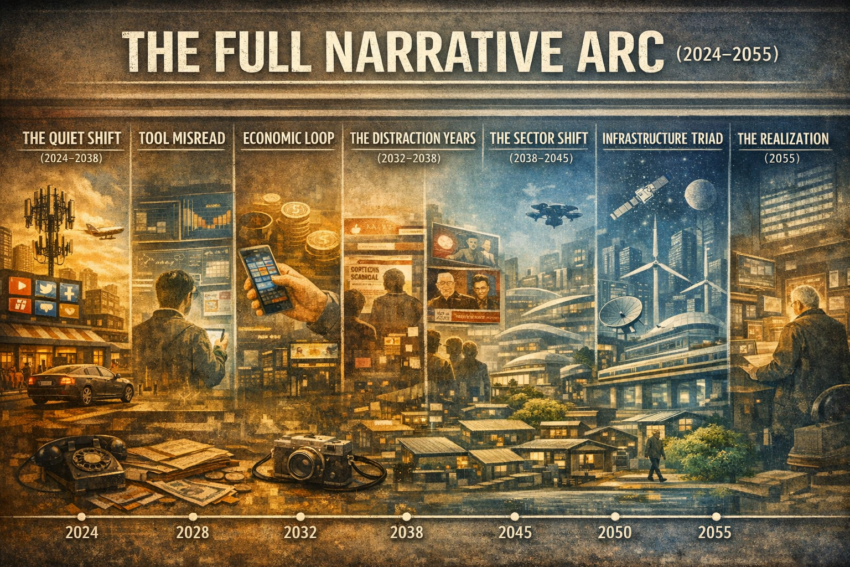
A world that doesn’t collapse — it updates.
I. THE YEARS NO ONE NOTICED (2024–2028)
The Quiet Shift begins.
The story opens in the most unremarkable way possible: with updates.
- A new digital ID app
- A new “temporary” emergency measure
- A new payment system
- A new housing initiative
- A new predictive algorithm
Each change is small enough to ignore. Each tradeoff feels reasonable. Each loss is incremental.
People don’t lose freedom. They trade it — a little at a time.
This period establishes the emotional truth of your world: the future arrives quietly.
II. THE TOOLS WE IGNORED (2024–2032)
The architecture is built in plain sight.
This act shows the early tools that everyone misunderstood:
1. Predictive Policing → Predictive Governance
Palantir’s early systems aren’t about crime. They’re about population modeling.
The police precinct becomes the prototype for the Sector Office.
2. Carbon Markets → Universal Pay
If you can financialize carbon, you can financialize anything. Human activity becomes a measurable unit.
This is the DNA of the programmable ledger.
3. Privatized Surveillance → Territorial Oversight
Satellite networks sold as “environmental monitoring” quietly become the first draft of population management.
4. Stablecoins → Digital Governance
Argentina becomes the testbed. Stablecoins fill the vacuum of collapsing currencies. People think they’re opting out — they’re opting in.
This act ends with a simple realization: the tools weren’t warnings — they were blueprints.
III. THE COMPANY STORE RETURNS (2026–2036)
Economic captivity replaces political conflict.
This is where the world begins to feel different, but still familiar.
A. Housing Consolidation
Private equity acquires entire neighborhoods. Employment‑tied residency returns. The company town is reborn.
B. Automation and Absence
Entry‑level jobs vanish. Career ladders collapse. People drift into dependency.
C. Penal Labor and Work Farms
Minor infractions become pathways into labor zones. Scrip replaces wages. Debt replaces freedom.
D. The Loop Forms
Housing → labor → incarceration → housing. A closed system. A self‑reinforcing cycle.
This act is observational, documentary, and mythic — no heroes, just systems.
IV. THE DISTRACTION YEARS (2032–2038)
The public looks away at the exact moment the system locks in.
A single, emotionally radioactive scandal consumes the nation. Not coordinated — just overwhelming.
People become:
- outraged
- obsessed
- exhausted
- burned out
And eventually… they tune out.
While the public argues, the real machinery advances:
- predictive governance
- digital rationing
- standardized housing
- algorithmic work assignments
- privatized infrastructure
This act is the hinge: the world doesn’t fall — it drifts.
V. THE SECTORING (2038–2048)
Logistics replaces ideology.
The country reorganizes itself not by politics, but by resource logic.
A. Population Balance Sectors
Movement becomes an allocation. Mobility scoring replaces freedom of movement.
B. Resource Sectors
Water tables, energy grids, and land use drive population placement.
C. Administrative Sectors
Predictive work assignments. Standardized consumption. Universal Pay as the rationing interface.
People aren’t punished. They’re redirected.
Not arrested. Reassigned.
This is where the world becomes recognizable as 2055 — but still feels like a natural extension of the present.
VI. THE CONVERGENCE (2048–2055)
Infrastructure becomes governance.
The four layers of the 2020s sensor stack finally merge:
- Sidewalk → the mesh
- Familiar Faces → identity resolution
- Flock → mobility ledger
- Palantir → predictive governance
And above them:
- AWS runs the digital grid
- BlackRock owns the physical grid
- Palantir interprets the data from both
This triad becomes the quiet architecture of global governance.
Not a dictatorship. Not a cabal. Just systems doing what systems do: optimizing.
Optimization ends in standardization.
VII. THE MANAGED LIFE (2055)
The world that feels inevitable.
By 2055, life is:
- standardized
- managed
- optimized
- predictable
- quiet
People live in modular housing. They work assigned roles. They move on scheduled corridors. They consume within allocated limits.
Not because anyone forced them. Because the system made it easy.
Convenience became governance. Efficiency became ideology. Stability became the only value that mattered.
VIII. EPILOGUE — THE REALIZATION
The world didn’t collapse. It updated.
By 2055, people look back and realize:
There was no Day One. No revolution. No takeover. No turning point.
Just a long, unremarkable stretch of days where everything shifted one inch at a time.
The future didn’t arrive with force. It arrived with frictionless updates.
And the only surprising thing is that anyone ever thought it would end any other way.