

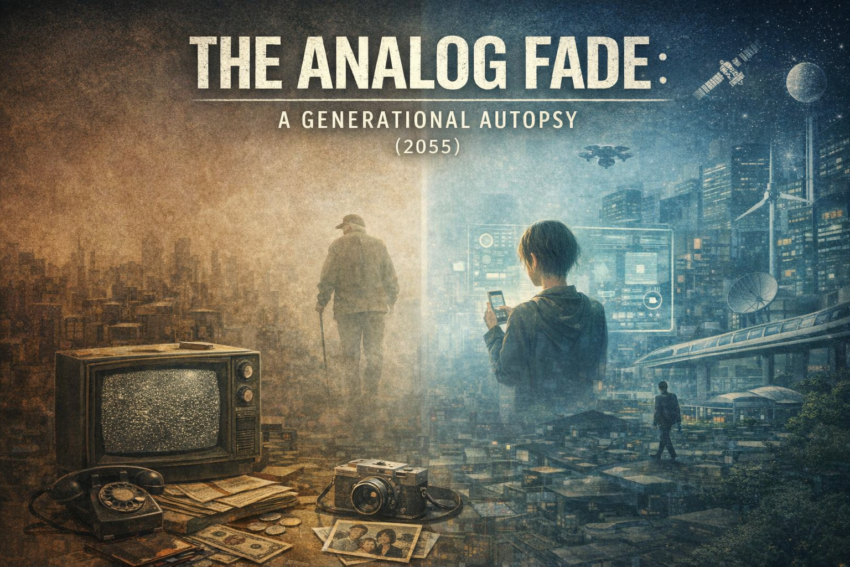
The Analog Fade: A Generational Autopsy (2055)
Published in the Journal of Transitional Studies, Sector 3 Administrative Zone
I. Introduction: The Last Constraint
By 2055, it is difficult for younger citizens to imagine a world in which daily life was not mediated by the digital substrate. The idea that movement could be untracked, purchases unlogged, or identity unverified feels almost mythological — a relic of a less coordinated age.
But for those of us who study the Transition Era, the most important force shaping the modern world was not technology, policy, or ideology.
It was demographics.
The world we inhabit today did not require a revolution.
It required a generational turnover.
The analog generation — those born before the substrate — was the last population with a living memory of unstructured life. Their disappearance removed the final friction point in the system’s maturation.
This is the story of that disappearance.
II. The Nature of Analog Memory
The analog generation carried with them a set of experiences that no longer exist:
- privacy as a default
- cash as an untracked medium
- movement without scoring
- work chosen rather than assigned
- identity as a personal attribute, not a network property
- infrastructure as background, not governance
These memories were not ideological.
They were experiential.
And experiential memory is the only force that can meaningfully resist systemic drift.
As long as the analog generation lived, the system had to justify itself.
It had to explain, persuade, soften, and delay.
This is what political theorists of the 2030s called the Time‑Buying Period.
III. The Time‑Buying Period (2024–2040)
Public officials of the era spoke in a distinctive tense — the future conditional:
- “We may be heading toward a world where corporations rival states.”
- “We must ensure predictive systems don’t overreach.”
- “We need safeguards as digital identity expands.”
These were not warnings.
They were temporal buffers.
The systems they described were already operational.
But the analog generation was still alive, still voting, still remembering.
So leaders spoke as if the transformation was emerging, not complete.
This rhetorical softening bought the system time — not to hide, but to normalize.
IV. The Digital Birthright (2035–2055)
Children born after 2035 entered a world where:
- digital ID was issued at birth
- universal pay was the only currency
- mobility scoring was routine
- sector housing was standard
- predictive work assignment was unremarkable
- satellite‑based resource allocation was simply “how things work”
They did not lose freedoms.
They never possessed the analog versions to compare against.
To them, the substrate was not a system.
It was the environment.
By 2055, 92% of the global population was born after the substrate’s consolidation.
The analog generation had dwindled to statistical insignificance.
With their passing, the last comparative memory vanished.
V. The Moment the System Stopped Explaining Itself
Historians mark the year 2048 as the inflection point.
That was the year when:
- public briefings stopped referencing “temporary measures”
- sector assignments no longer included opt‑out clauses
- universal pay transitioned from “support” to “standard”
- mobility scoring ceased to be framed as “safety”
- predictive redirection replaced punitive enforcement entirely
Nothing dramatic occurred.
No laws were overturned.
No announcements were made.
The system simply stopped explaining itself.
Not out of secrecy.
Out of irrelevance.
There was no longer an audience that remembered alternatives.
VI. The Final Years of the Analog Generation
The last analog cohort — those born before 2000 — entered their fifties and sixties during the Sectoring Era. Many adapted. Some resisted. Most simply aged out of public life.
Their objections were often dismissed as nostalgia, even when they were accurate.
They spoke of:
- unmediated choice
- untracked movement
- unscored consumption
- unassigned work
- unmonitored land
To digital natives, these concepts sounded like fiction.
By 2050, the analog generation represented less than 10% of the population.
By 2055, less than 3%.
Their passing was not mourned politically.
It was simply absorbed into the system’s natural progression.
VII. The World After the Fade
Today’s world — standardized, optimized, predictive — is not the product of coercion.
It is the product of inheritance.
The digital generation inherited:
- a mesh that sees
- an identity layer that recognizes
- a mobility ledger that forecasts
- a governance engine that anticipates
They inherited a world without friction, without ambiguity, without the analog gaps that once defined human life.
And because they inherited it, they accept it.
Not out of obedience.
Out of familiarity.
VIII. Conclusion: The Quietest Revolution in History
The Analog Fade was not a political event.
It was a demographic one.
The world did not change because systems grew stronger.
It changed because the population that remembered alternatives grew smaller.
When the last analog memories dimmed, the substrate no longer needed to justify itself.
It simply became the world.
The great lesson of the Transition Era is this:
Civilizations do not transform when systems evolve.
They transform when the people who remember the old system disappear.
The analog generation was the final tether to a world of unstructured life.
With their passing, the update completed installation.
Quietly.
Inevitably.
Permanently.