

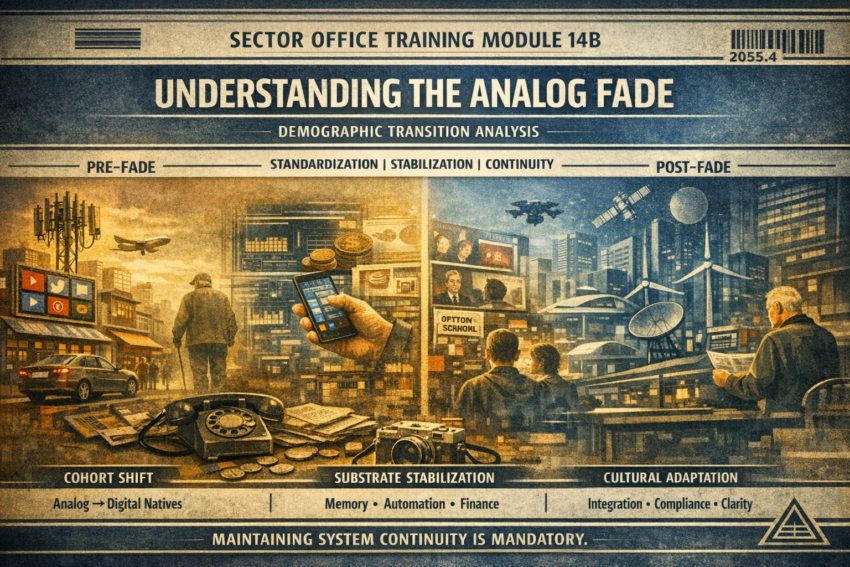
Orientation Briefing: Understanding the Analog Fade
Issued by: Directorate of Population Continuity Revision: 2055.4 Classification: Routine Training Material
I. Purpose of This Module
This module provides Sector Officers with foundational knowledge of the Analog Fade, the demographic transition that shaped the modern allocation environment. Understanding this transition is essential for effective communication, compliance management, and population guidance.
The Analog Fade is not a historical event. It is a completed demographic process.
II. Definition: What Is the Analog Fade?
Analog Fade refers to the gradual disappearance of individuals born before the establishment of the digital substrate (pre‑2030 birth cohorts). These individuals possessed experiential memory of:
- untracked movement
- unscored consumption
- non‑programmable currency
- non‑standardized housing
- self‑directed labor pathways
- identity not linked to the network
Their passing removed the final population segment capable of comparing the current system to pre‑substrate life.
This transition was natural, predictable, and essential for system stability.
III. Why the Analog Generation Mattered
The analog population represented the last significant source of:
- behavioral variance
- policy resistance
- non‑compliant expectations
- legacy interpretations of autonomy
Their lived experience created friction with early allocation models. This required:
- additional explanation
- extended opt‑out provisions
- transitional allowances
- rhetorical softening by public officials
These measures are no longer necessary.
IV. The Time‑Buying Period (2024–2040)
During this period, public communication emphasized:
- “temporary measures”
- “pilot programs”
- “voluntary participation”
- “emerging technologies”
- “future risks”
This language was not deceptive. It was adaptive.
The analog population required gradual normalization. Digital natives do not.
By 2040, over 70% of the population had no memory of pre‑substrate life. By 2050, over 85%. By 2055, the Analog Fade is considered complete.
V. Characteristics of Digital‑Native Populations
Digital‑native citizens (born 2035 and later):
- accept identity‑linked access as standard
- view mobility scoring as routine
- understand allocation as fairness
- interpret predictive redirection as safety
- expect standardized housing
- rely on universal pay as the default medium
- perceive the substrate as the environment, not a system
They do not require justification. They require clarity and consistency.
VI. Implications for Sector Officers
1. Communication Protocols
Avoid references to:
- “old systems”
- “previous freedoms”
- “pre‑digital norms”
These concepts are confusing to digital‑native citizens and irrelevant to operational outcomes.
2. Compliance Management
Digital natives respond best to:
- clear thresholds
- transparent scoring
- predictable redirection
- consistent messaging
Analog‑era appeals (choice, autonomy, exception) are ineffective.
3. Allocation Guidance
Digital natives interpret allocation as:
- fairness
- stability
- environmental balance
- community alignment
Sector Officers should reinforce these frames.
VII. Handling Remaining Analog‑Era Individuals
A small number of analog‑era individuals remain in assisted living or low‑mobility zones. Officers should:
- use simplified explanations
- avoid technical terminology
- provide extended transition windows
- document recurring confusion
These individuals are not non‑compliant. They are non‑native to the substrate.
Their needs should be met with patience and clarity.
VIII. Conclusion: The End of Comparative Memory
The completion of the Analog Fade marks the stabilization of the modern allocation environment.
With the passing of the last analog generation:
- the substrate no longer requires justification
- predictive governance operates without friction
- population guidance is fully normalized
- sector balance is maintained with minimal intervention
The world did not change abruptly. It changed demographically.
Your role as a Sector Officer is not to enforce the system. It is to maintain the stability that the Analog Fade made possible.