“Some folks talk… Some folks get things done.” — Bobby Likis
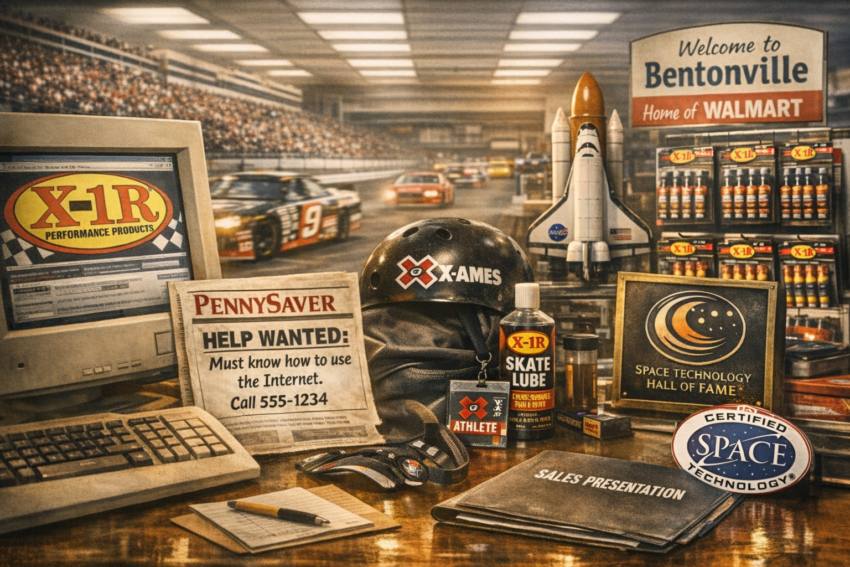
I didn’t go looking for the automotive world. It found me the same way most things do — through a side door, half by accident, half by instinct. Sun Coast Chemicals, makers of X‑1R Performance Lubricants had placed an ad in the local Penny Saver:
“Part‑time position for local business. Must know how to use the internet.”
That was it. No job title. No description. No hint of the noise and horsepower waiting behind the door. Just a line in a free paper, wedged between yard sales and handyman services.
Back then, “knowing how to use the internet” was still treated like a party trick. Most companies didn’t understand it, didn’t trust it, and didn’t think it mattered. But they knew they needed someone who could navigate it, and that was enough to get me in the room.
As “the computer guy”, I walked into a small commercial facility tucked behind an industrial park — fluorescent lights, mismatched furniture, the faint smell of rubber and ambition. They expected someone who could check email and maybe update a webpage. What they got was someone who saw the whole board the moment he stepped inside.
And just like that, the pattern began again.
I was hired part‑time to “use the internet,” which in 1998 meant setting up email accounts, teaching the staff how not to break the browser, and updating their primitive website. I did the real work at home, where I could move fast, think clearly, and keep the process mine. I convinced them to pay RPP separately for the website rebuild — a clean line between their payroll and my craft. That was intentional. That was survival.
I’ve always worked the same way — fast, focused, and alone. If someone stood over my shoulder, which often was the case, I’d move so quickly they couldn’t keep up. After a minute or two they’d get so confused, tap out, and say something like, “You got this, I’ll come check on it later.” That was the point.
I didn’t mind teaching people the basics — how to get around online without getting lost, how to keep the machine running, how not to click the wrong thing. But when it came to design, structure, and the actual build, that was my domain.
Once the new site was live, they were impressed enough to pull me inside and give me a desk. That meant letting go of RPP, at least on paper. The first project they handed me was a product they’d created but didn’t know how to position. Truth is, it was smart — a line of small‑bottle sports lubricants made from the same space‑age formula they used in automotive applications and used by NASA. Same chemistry, different market, twice the price.
I designed the packaging, built the graphics, and created the entire look and feel. All in my lane.
And because the internet was still the Wild West, I went straight to the source. I reached out to X Games athletes, not as sponsor, as a fan. The event was in its first year and I asked if they’d try our Skate Lube. We sent out swag bags, built buzz, made a little noise. It worked.
And yes, I made my boss look good. That’s always been part of the job.
After the Skate Lube push started gaining traction, the owners decided it was time to swing for the fences. Walmart. Shelf space. National distribution. A completely different league.
They flew me out to Bentonville with them — my first real look at how the big players moved. The scale of it. The machinery. The choreography of corporate power. It was a whole new world, and I treated it the same way I treated everything: as an opportunity to learn.
Walmart didn’t take meetings just because you asked. You had to check off a list before they’d even open the door. X‑1R had Pep Boys and was closing in on AutoZone. They’d hit their quota for advertising. They had the NASA endorsement. And now, thanks to me, they had a real web presence — something polished enough to look like they belonged in the conversation.
We got our shelf space. Modest real estate, but real estate all the same. Once I designed the required blister‑pack hanging rack — approved, compliant, and built to their specs — Walmart expanded the order. They took the Gun Lube, the Fishing Lube, and the Skate Lube for their sports department.
A small footprint in a massive machine, but it was a foothold. And in that world, a foothold is everything.
Although I wasn’t there long, their sandbox offered opportunities most people will never see. The work opened doors that don’t open twice.
I saw how the Walmart game was played from the inside and had a voice in negotiations for shelf space. I was at the induction ceremony for NASA’s Space Technology Hall of Fame and got a private tour of the shuttle crawler — a machine that feels more like a moving continent than a vehicle. We were the main sponsor on Mike Wallace’s Chevy in the 40th running of the Daytona 500, with all the access and noise that came with it. I watched Buck Parker run the X‑1R Corvette in the 1998 Car and Driver One Lap of America. We had sponsorships at every Daytona race-track. I even ended up as an Executive Producer of a nationally syndicated radio show — Bobby Likis’ Car Clinic — and caught an early brush with what would become the world’s biggest extreme‑sports stage: the first‑year X Games.
It was a short chapter, but a hell of an education.