

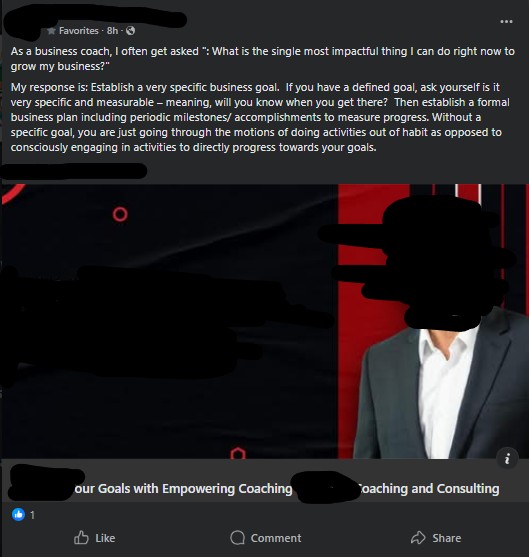
Look who’s firing up the ole’ grift. I guess his new “real job” with that start‑up didn’t work out. I’m sad I ever helped him create that successful‑looking business. He’s offering a service he doesn’t know how to do. I know because he hired me to point out the single most impactful thing he could do to grow his business.
Seeing his post felt like driving past a Ferrari you once built and spotting a Ford mechanic under the hood, wrenching at parts he doesn’t understand. Same car. Same paint. Same badge. Wrong hands. And you already know how that ends.
It always started the same way:
“Can you…?”
And my answer:
“Absolutely.”
With musicians, it was gigs and chart movement.
With small businesses, it was visibility and client acquisition.
Different lanes, same mechanics.
I always built the beautiful parts first — the eye candy, the tangibles that justify the expense. The graphics, the videos, the polished identity that made a tiny operation look like a full‑scale corporation. Something they could show off. Something they could point to and say, “Look what I’m doing,” even though they weren’t doing it.
Meanwhile, I was stitching together the real machine underneath:
- social media to website
- website to Yelp
- Yelp to funnel
- funnel to portal
- portal to analytics
- analytics to ads
The hard stuff.
The smart stuff.
The stuff they never saw and never understood.
I always worked transparent and clean.
Every username, every password, every admin login — documented.
I’d hand them their keys and have them look under the hood.
They’d stare at the wiring like it was written in a language no one speaks, nod politely, say “looks great,” and close it right up.
Month One was always the dopamine month.
They loved the shine.
They loved the illusion of momentum.
They loved the feeling of scale.
Month Two was where the invisible work lived — the integrations, the API keys, the Google tracers, the ads, the verification loops, the funnel routing. Hours of work that look like nothing. The part that feels like talking French to a fish when you try to explain it.
By Month Three, the shift always came.
My part was done.
Now it was their turn.
And that’s when the excitement turned into overwhelm.
Not because the system was flawed — but because the system required them to show up.
And this was always the part no one saw:
I stayed five steps ahead.
Not to impress anyone — but because that was the only way the machine held together. While they were still admiring the paint job, I was already deep into the next cycle, anticipating the bottlenecks, patching the weak points, and preparing for the moment they’d inevitably fall behind.
That’s why I kept everything on three‑month, non‑binding handshake agreements. No contracts. No traps. No obligations. The client always took the out first anyway. Three, six, nine months — that was the lifespan. By the second cycle, I was already scanning for my next client. I knew I had about a month of runway.
And I never took more than three clients at a time. Not a gimmick. Not a scarcity play. Just the only way to keep the work clean and the exits clean.
All my pitches came wrapped as an opportunity. I never asked to work for anyone. I offered them the opportunity to work with me. People felt that difference even if they couldn’t articulate it.
Then, inevitably, someone would ask the client the one question I would never ask anyone: “How much you paying him?” And that was always the beginning of the end. My value was never put on display — intentionally. I didn’t itemize what I did or parade the workload. So when someone came along offering a cheaper service, I understood. They were comparing prices, not systems. What they didn’t see was that I wasn’t offering a task. I was quietly offering a suite of services. I knew my value. If the client didn’t see it, they eventually proved it, and they weren’t going to succeed with or without me.
And here’s the part that always lands the same way: About a week after a client left, I’d go back and visit the URL I built a city around. And every time, the unique, well‑curated site I created had been torn down and replaced with an ill‑conceived, cookie‑cutter template. Broken links. Missing integrations. All the functionality gone. A Ferrari reduced to a kit car.
It didn’t hurt. Not even a little. Because I knew exactly what that moment meant.
After the client realized they made a mistake, they never called me. Not out of anger. Not out of pride. Out of embarrassment.
I was so quietly good for them that they didn’t realize how much I was doing until the moment everything stopped working. And once they understood it, they couldn’t bring themselves to say it out loud.
That silence wasn’t rejection. It was recognition.
So when I saw his post — the recycled language, the recycled identity, the recycled grift — it didn’t sting. It just confirmed the pattern. He’s out there trying to fix a machine he never understood, using the same tools he once paid me to assemble. Trying to resurrect a business offering services he still doesn’t know how to do.
It’s not judgment. It’s not bitterness. It’s just the shape of the story. And the tale continues from there.