

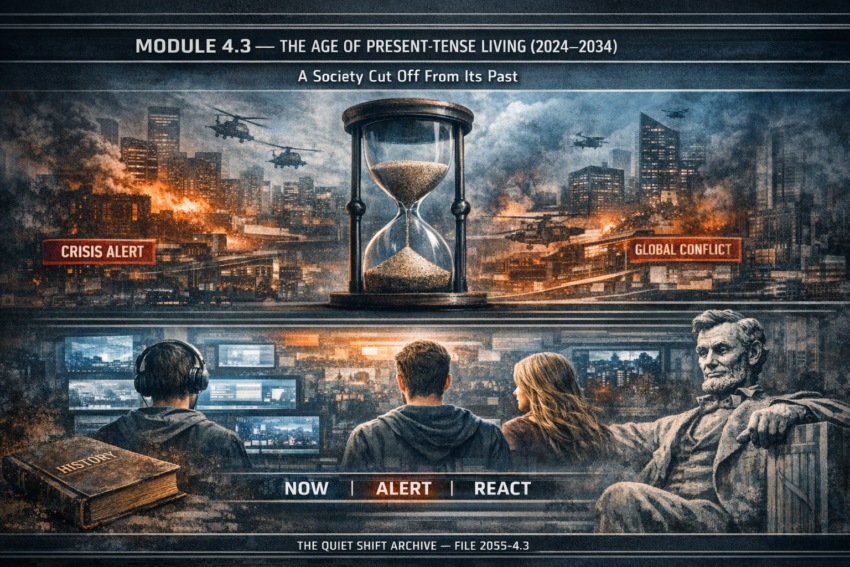
Recovered Fragment — The Quiet Shift Archive (2055 Edition)
I. The Compression
By the mid‑2020s, global instability had compressed public attention into a narrow band of immediacy.
People no longer lived in time — they lived in alerts.
- Crisis replaced continuity
- Reaction replaced reflection
- The present replaced the past
This was not ideological.
It was environmental.
A population raised inside rolling emergencies learned to see the world as a sequence of now‑events, each demanding total focus until the next one arrived.
II. Institutional Drift
Governments caught in global turbulence defaulted to crisis‑mode communication:
- urgency over context
- threat over history
- action over understanding
The unintended lesson was simple:
Only the present matters.
Historical literacy didn’t erode — it was crowded out.
III. The Generational Break
The youngest cohort entered adulthood without a functioning memory scaffold.
They inherited:
- fragmented narratives
- algorithmic timelines
- politicized noise
- a culture of acceleration
They were not “uninterested” in the past.
They were never given the conditions to access it.
Learning requires:
- stability
- continuity
- narrative space
All three were missing.
IV. The Public Admission
Early‑century leaders occasionally voiced frustration that “people aren’t learning from history.”
In the 2055 archive, these statements are treated as diagnostic artifacts, not political ones.
They reveal:
- a recognition that memory transmission had failed
- an awareness that institutions had lost their narrative function
- a society unable to slow down long enough to understand itself
The admission was accurate.
The cause was structural.
V. The Consequence
A society that cannot acknowledge its past becomes trapped in repetition loops:
- the same mistakes
- the same conflicts
- the same shocks
- the same reactions
Not because people are careless, but because the memory infrastructure collapsed under the weight of continuous crisis.
VI. The 2055 Interpretation
From the vantage point of 2055, Module 4.3 is the hinge where historians mark the transition from:
a culture with a past → to a culture without one.
The lesson extracted is concise:
A society cannot learn from a past it no longer remembers how to access.
This fragment sits in the archive as a warning, a mirror, and a map of how drift becomes destiny when memory is no longer maintained.