

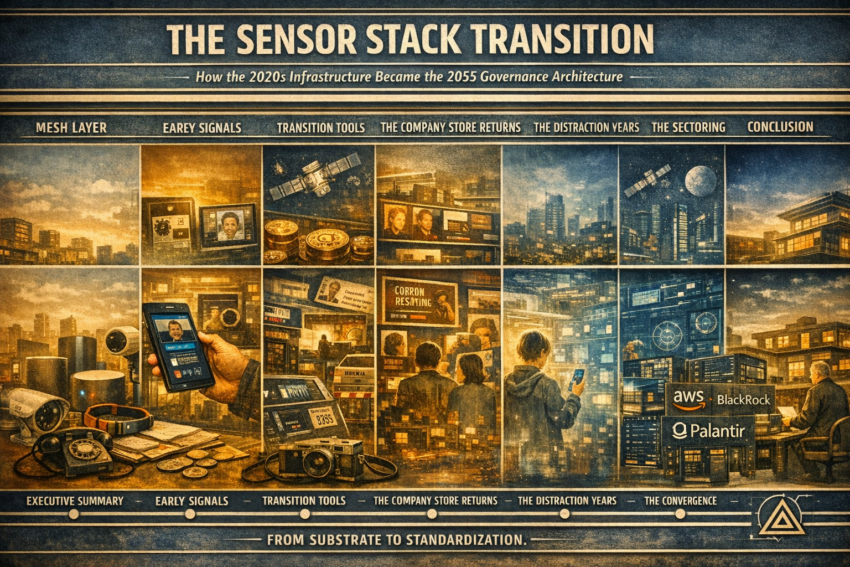
I look back at the early 2020s now and it’s obvious: the future wasn’t built by governments, elections, or revolutions. It was built by infrastructure — the kind people installed in their homes, clipped to their keychains, bolted to street poles, or embedded in the apps they used every day.
The shift to 2055 didn’t feel like a takeover. It felt like an update.
What we now call the Global Allocation System didn’t begin as a governing body. It began as a stack — a loose federation of private networks that gradually learned to talk to each other. Amazon Sidewalk. Ring’s Familiar Faces. Flock’s vehicle‑recognition grid. And Palantir, sitting quietly in the background, doing what it always does: stitching fragments into a coherent picture.
Individually, none of these systems looked like governance. Together, they became the nervous system of a world that no longer needed traditional government at all.
1. The Mesh Layer (Sidewalk) → The Ambient Infrastructure of 2055
Sidewalk was the first hint of what was coming: a civilian‑built mesh network that didn’t rely on cell towers or Wi‑Fi. It was the connective tissue — the part nobody noticed because it lived inside doorbells, speakers, and pet trackers.
By the mid‑2030s, Sidewalk‑style mesh networking wasn’t a feature. It was the default substrate of urban life. Every appliance, every mobility device, every standardized home in the sectors came pre‑meshed.
By 2055, the mesh isn’t “Amazon’s” anymore. It’s simply the network — the ambient layer that makes universal pay, predictive allocation, and mobility scoring possible. It’s the air the system breathes.
2. The Identity Layer (Familiar Faces) → The Person‑Resolution Engine
Ring’s “Familiar Faces” was marketed as convenience: Know who’s at your door. Recognize your kids coming home.
But the real innovation wasn’t the camera. It was the identity resolution — the ability to say: “This face belongs to this person, who belongs to this household, who belongs to this account.”
By the 2030s, face‑matching wasn’t a feature of cameras. It was a property of the network. Every public surface — transit hubs, standardized housing, mobility checkpoints — used the same underlying identity layer.
By 2055, identity isn’t something you present. It’s something the system recognizes.
3. The Mobility Layer (Flock) → The Movement Ledger
Flock’s license‑plate network was the first mass‑adopted mobility‑tracking grid that wasn’t built by a government. It didn’t need to be. Neighborhoods bought it. HOAs bought it. Police departments bought it.
It spread the way weeds do: quietly, opportunistically, filling every gap.
By the 2030s, Flock‑style vehicle signatures — make, model, color, roof rack, bumper sticker — were just another data stream. Cars became nodes. Roads became sensors. Movement became data exhaust.
By 2055, mobility is no longer a right. It’s an allocation, scored and forecasted by the system the same way energy and food are.
4. The Fusion Layer (Palantir) → The Predictive Governance Core
Palantir was never a surveillance company. It was a correlation company. It didn’t need to own the sensors. It only needed the streams.
Sidewalk gave it device movement. Familiar Faces gave it identity. Flock gave it mobility. Banks, insurers, hospitals, and retailers gave it everything else.
By the 2030s, Palantir wasn’t “an analytics platform.” It was the operating system of institutions.
By 2055, it becomes the governance engine — the part of the system that forecasts demand, assigns work, allocates resources, and redirects people long before conflict or scarcity appear. Not policing. Not punishment. Just predictive redirection.
The system doesn’t enforce. It anticipates.
The Convergence: How the Stack Becomes Governance
The transition wasn’t dramatic. It was incremental, almost polite.
- The mesh layer made everything visible.
- The identity layer made everyone legible.
- The mobility layer made movement predictable.
- The fusion layer made society optimizable.
Once those four layers stabilized, the rest was inevitable:
- Universal Pay became the resource‑allocation interface.
- Sector housing became the population‑distribution interface.
- Predictive work assignments became the labor‑stability interface.
- Mobility scoring became the behavior‑shaping interface.
By 2055, the system doesn’t feel like surveillance. It feels like order — the quiet hum of a world where everything is tracked, forecasted, and balanced long before humans notice the imbalance.
People don’t fear it. They rely on it.
The Real Story
The 2055 architecture isn’t a dystopia. It’s the logical endpoint of a world that outsourced coordination to infrastructure.
Sidewalk taught the system where everything is. Familiar Faces taught it who everyone is. Flock taught it how everyone moves. Palantir taught it what everything means.
The rest — the sectors, the universal pay, the predictive governance — is just the system following its own logic to its natural conclusion.
Not collapse. Not takeover. Just transition.
A drift from governance by institutions to governance by infrastructure.