I was born into a family already halfway through its story. My older siblings were children of the 1950s — raised in a world of stricter rules, tighter expectations, and parents who were still young enough to worry about everything. By the time I arrived in 1963, my parents had already lived through the noise and chaos of raising four kids. I was the only one born in the 60s, and that made my childhood something entirely different.
My sisters were my babysitters until suddenly they weren’t. They grew up, moved out, and left behind a house that had gone quiet. My mother had a baby at home again, but she wasn’t the same woman she’d been in the Eisenhower years. My father was working steady hours, older now, more settled. They weren’t anxious anymore. They weren’t hovering. They weren’t projecting fear.
They were simply tired enough and confident enough to let me grow up without fences.
I wasn’t neglected. I was trusted. And that trust became freedom.
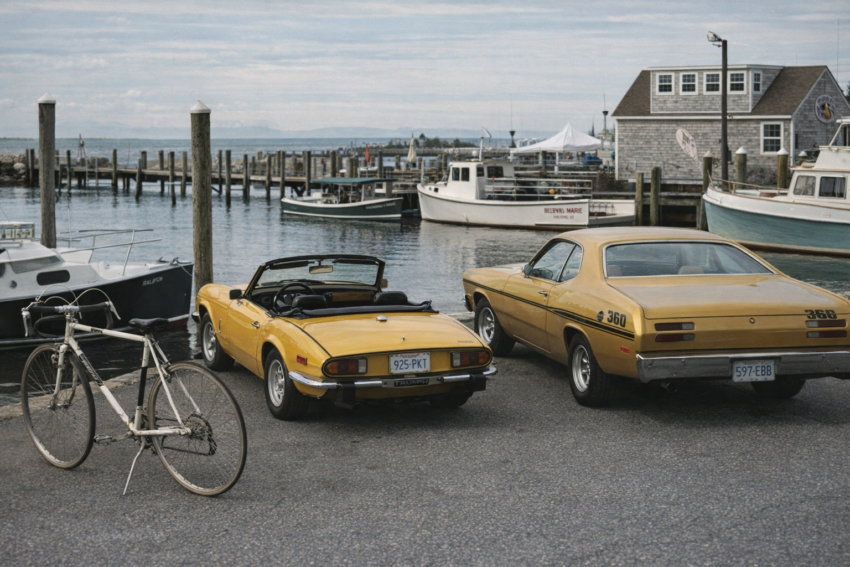
At fourteen, that freedom had a physical shape: a bike, a hill, and a straight shot from 53 Orchard View Road to the Guilford docks — Four miles at half a mile a minute, mostly downhill. That ride wasn’t just transportation. It was the first terrain I mastered without supervision, the first stretch where my body could outrun my thoughts, the first time Guilford felt bigger than my neighborhood.
Kids don’t think in metaphors, but adults looking back can see the architecture. That ride was my first lesson in leaving home and returning on my own terms.
And the docks were the first place that felt like a world.
The Guilford docks was more than a hangout were the older teens gathered. They were a working waterfront — salt, diesel, rigging clattering in the wind, men who knew tides better than clocks. And in the middle of that world was Don Lowell, the dock master who decided two kids on bikes were worth teaching.
He bought us lunch. He took us out to snag bunkers and chase mackerel for bluefish bait. He taught us to make sinkers, to fuel boats, to clean bathrooms without cutting corners, to read the water, to read the weather, and to read the men who worked there.
It wasn’t mentorship in the formal sense. It was apprenticeship by proximity — the kind boys stumble into when an adult sees potential and decides not to waste it.
The docks became my teenage third place. Not a mall. Not a parking lot. A working system with rules, rhythms, and characters. A place where I could be useful. A place where I belonged. A place where adults treated me like someone who mattered.
Those instincts — patience, timing, knowing when to move and when to wait — followed me into retail, into New Haven, into every system I learned to navigate later in life.
Freedom attracts stories, and mine often arrived on four wheels.
The first was a 1974 Triumph Spitfire — not because I wanted it, but because my brother was moving to Texas and couldn’t take it with him. I picked up the payments and drove it because that’s what you do when life hands you a car at seventeen. I wasn’t a car guy, but I was a kid with mobility, and that was enough.
When it needed work, I found a parts car in a salvage yard and tried replacing the exhaust manifold with a friend. We forgot the gasket. The Spitfire caught fire. That was the end of that.
I brought the charred remains to my sister’s boyfriend’s garage. He showed up at my job — grease on his hands, still in his work clothes — tossed my keys at me in front of a mom and her kid, and said, “If I need shoes, I’ll come see you. Stay the hell out of your engine.” Then he did me a “favor” and handed me $700, told me to get the title to him and walked out.
That money turned into a Dodge Dart Sport 360. Muscle instead of British quirk. Still not a car guy. Still just moving.
By the time I moved into my first apartment in New Haven, the Dart was paid for. I was nineteen, working full‑time at Macy’s a few blocks away, and living like someone who had already been on his own for years.
One day the Dart disappeared. I didn’t panic. I didn’t even look for it. I’d already written it off. Weeks later, walking home from work, I spotted it behind a fence at an impound lot. Out of curiosity, I asked about it. The storage fees were higher than the car was worth.
So, I told them to keep it.
That was the whole story. No drama. No attachment. No identity tied to a vehicle. I walked home, same as always.
Looking Back
When I think about those years now — the docks, the cars, the apartment, the city — none of it feels like a defining moment. It feels like weather. Things that passed through while I stayed the same.
I wasn’t shaped by chaos or crisis. I was shaped by freedom — the kind that comes from being the second to last child in a family that had already lived through its storms. A new decade was forming, my parents had matured and had a new child to care for. My older siblings had moved on. The 70s were a different world than the 50s. And I was the kid who slipped into that gap and learned how to raise himself.
Not out of necessity. Out of opportunity.
And that freedom — that quiet, unstructured, unmonitored freedom — became the foundation for everything that came after.