

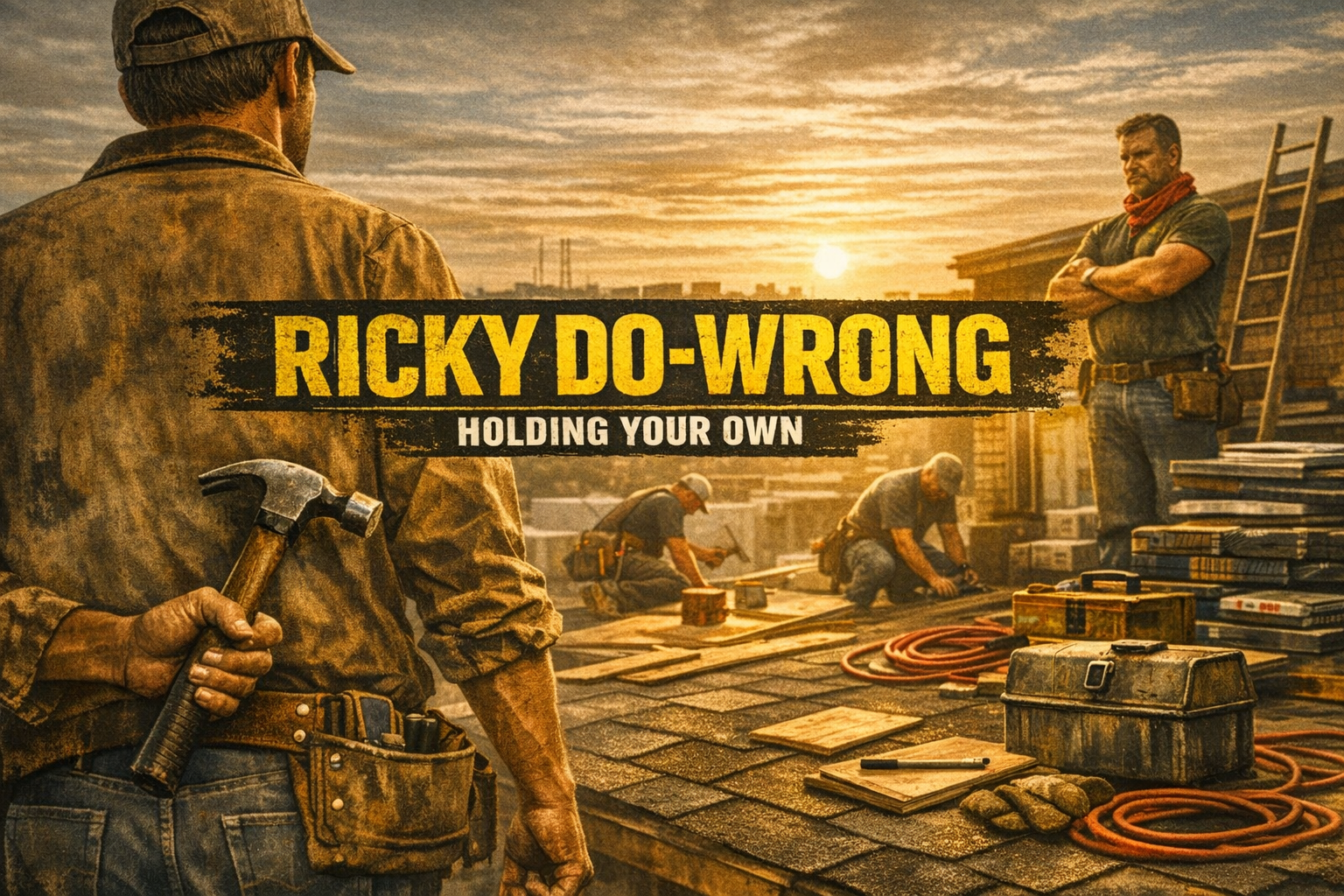
Every world I worked in required a different mask. Retail had one language. Construction had another. And neither one cared about the rules of the other.
On the roof, subtlety was useless. Sly barbs, clever retorts, the kind of dry wit that worked fine in a store didn’t land the same on a construction site. Not because they didn’t hear me, but because they weren’t listening for meaning. The communication was blunt, fast, and unforgiving. You learned by getting knocked around verbally, and you either held your own or you became the target. I wasn’t going to be the target.
The first time I heard it was a few weeks in: “Ricky do‑wrong.”
You don’t get a nickname like that because you messed up once or twice. You get a nickname like that by repeating a pattern — one everyone sees before you do.
And the second it hit my ears, I knew I had to make a hard course correction.
If I didn’t like being treated like a helper, I had to stop acting like one. I stopped trying to be clever. I stopped trying to match their humor. I learned to swing my hammer hard — not for show, but because that’s what the work demanded. I learned fast, and I learned publicly.
I adapted. I learned not to repeat mistakes. Then I learned not to make mistakes. And I learned to stand my ground without escalating anything. That was the real education — not the roofing, not the tools, but the ability to survive a culture that tested you every minute you were on the clock.
Once I understood the rules, I worked my way up the ranks quickly. I learned the harder I worked, the less hard work I had to do.
That experience shaped how I teach and how I lead. And when I was in charge, I didn’t humiliate.
Real communication — real leadership — has depth. It has timing. It has intention.
The roof taught me how to survive bluntness. Everything after that taught me how to communicate with intelligence. Different masks. Different worlds. Same lesson: If you don’t like the role you’re being handed, change the way you move. Hold your own, but don’t lower your standards to do it.
When I found myself back in environments where communication had layers again — where people understood nuance, timing, and intention — it felt like relief. I’ve always thought about comedians who go for the easy hit, the joke about someone’s appearance. That’s lazy and unsophisticated humor. And I think about that every time I’m in a position to lead.
Anyone can take the cheap shot.
Anyone can punch down.
But it takes intelligence — and discipline — to communicate in a way that builds instead of breaks.
And that nickname, Ricky do‑wrong, that I only ever heard once or twice, I carry like tuition to this very day.